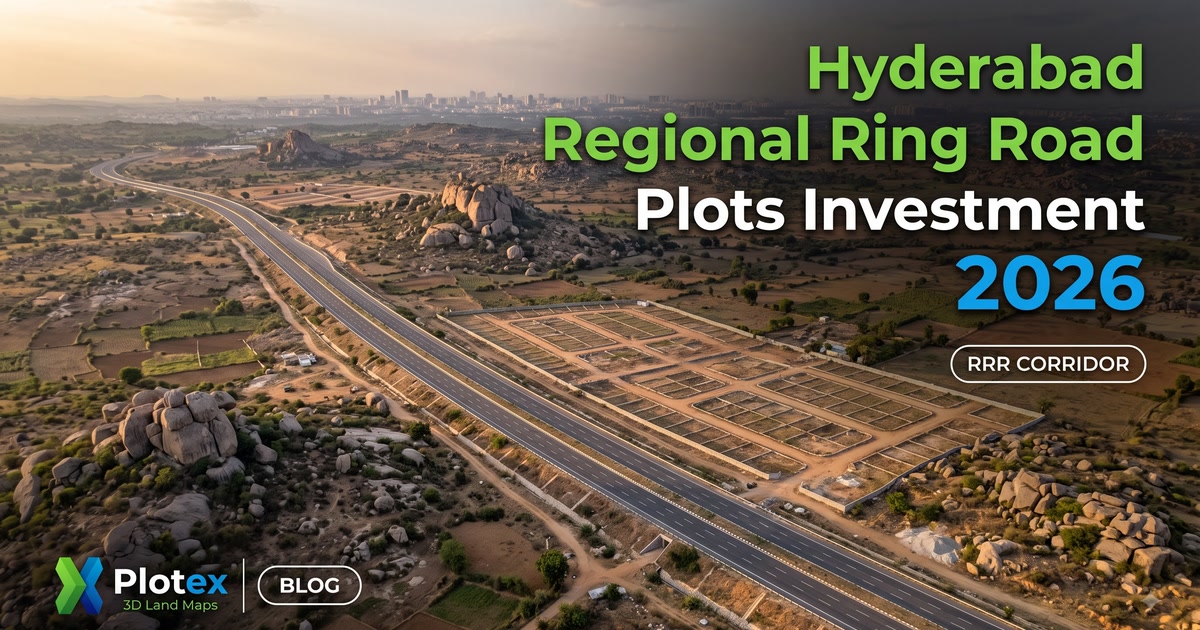
Hyderabad already has one ring road that changed the city permanently. The Outer Ring Road turned villages into suburbs and made a generation of early plot buyers look prescient. So when the state started building a second, much larger orbital — the Regional Ring Road, roughly 340 km and far beyond the ORR — every plot seller in Telangana started using the letters RRR.
Here is the thing most of them will not tell you. The RRR is not one project at one stage. Its northern corridor is largely land-notified and close to execution. Its southern corridor is still at the detailed-project-report and alignment stage, meaning the route itself is not final. A plot "on the RRR" therefore means two completely different things depending on which half you are standing in — and that single distinction is worth more to you than any price list. This guide covers the corridor as it actually stands in 2026, what the HMDA boundary extension changed, and the Telangana-specific approval traps — LRS, Dharani, unapproved ventures — that decide whether your plot is an asset or a problem.
Quick takeaway: The RRR's northern corridor (broadly Sangareddy to Choutuppal) has its land largely notified and is close to execution. The southern corridor is still at DPR stage with a route that can shift — cheaper, and genuinely speculative. Telangana has also extended HMDA's jurisdiction outward towards the alignment, changing who approves layouts in many villages. Before paying, check the survey number on Dharani, confirm the layout is genuinely HMDA-approved rather than LRS-pending, and verify TS-RERA.
North vs South — The Distinction That Decides Everything
The RRR is planned as a full orbital well outside the ORR, spanning several districts around Hyderabad and touching dozens of mandals and a large number of villages. It is executed in two halves, and they are not moving together.
| Northern corridor | Southern corridor | |
|---|---|---|
| Broad route | Sangareddy → Choutuppal side | Completing the loop via the Shadnagar side |
| Stage (2026) | Land largely notified, near execution | DPR / alignment stage |
| Alignment certainty | High | Can still shift |
| Land pricing | Already reflects the road | Cheaper, speculative |
| Suits | Lower-risk, moderate-upside buyer | High-risk, long-horizon buyer |
Read that table honestly and it tells you what you are actually being sold. On the north, the catalyst is largely locked in — the state has notified the land, the alignment is settled, and funding has been moving. You will pay for that certainty, and much of the easy appreciation has already happened. That is not a criticism; it is what a de-risked corridor costs.
On the south, the picture is different in kind, not just degree. When a corridor is still at DPR stage, the route can move. Land marketed today as "on the southern RRR" may end up several kilometres from the final alignment, and the plot that looked like a bargain becomes ordinary farmland with a story attached. There is a legitimate way to play the south — small allocation, long horizon, clean title, no premium paid for a route that is not final. There is no legitimate way to pay northern-corridor prices for southern-corridor certainty.
The general principle that applies across Indian highway corridors is worth repeating here: on an access-controlled road, interchange proximity beats carriageway proximity. Land that touches the road but has no entry point onto it gains far less than land a few kilometres away at a junction. Our guide on buying plots near expressways covers that mistake in detail.
What the HMDA Boundary Extension Changed
Telangana extended the Hyderabad Metropolitan Development Authority's jurisdiction outward towards the RRR alignment, pulling a large number of additional villages under HMDA's planning control. This is a bigger deal for plot buyers than it sounds.
It means two things at once. First, land that previously sat under looser local governance now falls under a metropolitan master-plan regime — which generally raises standards, brings zoning discipline, and over time supports values. Second, and more immediately relevant to you, it changes which authority is competent to approve a layout in those areas. An approval issued years ago by a different body is not automatically sufficient under the current jurisdiction.
So when a seller shows you a layout approval, do not simply check that one exists. Check who issued it, when, and whether it is valid for that land under the present jurisdiction and master plan. On a corridor where a lot of old inventory is being re-marketed under a new story, this is where quiet problems hide.
The Telangana Traps — LRS, Dharani, Unapproved Ventures
Unapproved ventures and LRS
Hyderabad has an unusually large stock of plots sitting in layouts that were never formally approved. The Layout Regularisation Scheme (LRS) exists to bring some of those into compliance, and a very large number of applications have been filed under it over the years.
The trap is straightforward and extremely common: an LRS application is not an approval. It is a pending request that may attract charges and conditions, and whose outcome is not guaranteed. Sellers hand over an LRS receipt with the confidence of someone handing over a sanction letter. Corridor hype makes this worse, because a road announcement pulls dormant unapproved ventures straight back into the market at prices they could never previously command.
Ask the direct question: is this layout approved by HMDA or the relevant authority, or is it LRS-pending? If it is pending, treat the plot as unapproved land at an unapproved-land price, and understand precisely what regularisation would require before you consider buying at all.
Dharani and restricted land
Dharani is Telangana's integrated land-records system, and it is the first place to take a survey number. Verify the record, and specifically confirm the land is not in a restricted category or on the prohibited-property list — land in those categories cannot be freely transacted, and buyers do get caught paying for land that was never transferable.
One important limit to understand. Dharani tells you about the land record. It does not tell you the layout is approved. Agricultural land showing cleanly on the portal is still agricultural land, not a residential plot — those are separate questions requiring separate documents. Confusing the two is one of the most common ways buyers convince themselves they have done their diligence when they have done half of it. Our guide on NA plot vs agricultural land explains why that distinction decides whether you can ever build.
How to Verify an RRR Corridor Plot
1. Establish which corridor — and how final the alignment is
Confirm whether the plot is on the northern corridor (notified, near execution) or the southern one (DPR stage, route can shift). Price and risk follow directly from this. Work from the official alignment, not a broker's map.
2. Check the survey number on Dharani
Verify the land record and confirm the survey number is not restricted or on the prohibited-property list, and note whether the classification is agricultural.
3. Get the actual layout approval — not an LRS receipt
Obtain the HMDA or relevant authority approval with your plot number visible on the sanctioned plan. If the layout is unapproved, establish the exact LRS position and what regularisation would require.
4. Obtain an encumbrance certificate
Get the EC covering an adequate period to confirm the title is free of mortgages, charges and disputed transactions.
5. Verify TS-RERA registration
Any developer-marketed plotted project of qualifying size should be registered with TS-RERA. Check the registration and confirm the layout and plot schedule match what you were shown. (See our RERA-approved plots guide.)
6. Match the plot on the ground to the sanctioned plan
Walk the site with the approved layout and confirm the plot number, dimensions, road frontage and neighbours. On large corridor ventures, plots get renumbered between the brochure and the sanction more often than buyers expect.
Where 3D Plot Visualization Helps
RRR-corridor ventures tend to be big — hundreds of plots across a wide site, often far from the city, often sold to buyers in the Gulf, the US or elsewhere in India who will visit once at most. That combination produces a specific failure: the legal diligence gets done properly, and then the buyer never actually confirms that the plot number on their agreement is the plot they walked on, or that the road frontage they were promised exists on the sanctioned plan.
An interactive 3D plot view closes that gap. A flat HMDA layout or survey PDF becomes a navigable map where every plot carries its number, dimensions, frontage and neighbours — openable from a phone anywhere. It does not replace the Dharani check or the approval letter; nothing does. It makes the last question — is this the plot on the sanctioned plan? — answerable without another trip to Telangana. If you market plots on this corridor, our Hyderabad plot layout page shows the format.

The Bottom Line
Hyderabad's ORR proved that a ring road can rewrite land values around this city, and the RRR is a large enough project to do it again over a long horizon. But the lesson from the ORR is not "buy anything near the new ring road." It is that the buyers who did well held clean, approved land long enough for the infrastructure to arrive — and the buyers who lost money held unapproved plots in ventures that never regularised.
So separate the two corridors before anything else. Pay for certainty on the north or pay less for speculation on the south, but do not confuse the two. Confirm who approved the layout under the current HMDA jurisdiction, check the survey number on Dharani for restrictions, refuse to accept an LRS receipt as an approval, and verify TS-RERA. A 340 km road will take years. The documentation either protects you for all of them or it does not.
Frequently Asked Questions
What is the Hyderabad Regional Ring Road (RRR) and what is its status in 2026?
The Regional Ring Road is a roughly 340 km outer orbital planned well beyond the existing Outer Ring Road, spanning several districts around Hyderabad and touching dozens of mandals and villages. It is split into a northern corridor running broadly Sangareddy to Choutuppal, and a southern corridor completing the loop via the Shadnagar side. As of 2026 the two halves are at very different stages — the northern corridor's land is largely notified and it is far closer to execution, while the southern corridor is still at the detailed-project-report and alignment stage. That difference is the most important fact for any plot buyer on this corridor.
Is the northern or southern RRR corridor better for buying a plot?
They are different risk profiles rather than better and worse. The northern corridor has notified land, an approved alignment and released state funding, so plots near it are priced on a catalyst that is largely locked in — less upside, much less uncertainty. The southern corridor is still at DPR stage, meaning the alignment can shift, so land there is cheaper but genuinely speculative. Buying on the south is a bet on a route that is not final. If a seller quotes the same confidence for both, they are not being straight with you.
What did the HMDA boundary extension to the RRR change?
Telangana extended the Hyderabad Metropolitan Development Authority's jurisdiction outward towards the RRR alignment, bringing a large number of additional villages under HMDA's planning control. For plot buyers this matters because it changes which authority sanctions layouts in those areas and brings previously loosely-governed land under a stricter master-plan regime. Practically, always confirm which authority approved the layout you are buying into and whether that approval is valid under the current jurisdiction — an old approval from a different body is not automatically sufficient.
What is LRS in Telangana and why does it matter for RRR plots?
LRS is the Layout Regularisation Scheme, the mechanism for regularising plots in layouts that were never formally approved. A very large number of plots around Hyderabad sit in unapproved ventures, and an LRS application does not by itself make a plot approved — it is a pending request, and charges plus conditions can apply. Corridor hype pulls unapproved ventures back into the market, so confirm whether the layout is genuinely approved by HMDA or the relevant authority, or whether you are being sold an LRS-pending plot with an unresolved status.
How do I check a Hyderabad plot on the Dharani portal?
Dharani is Telangana's integrated land-records system. Verify the survey number's record and confirm the land is not in a restricted category or on the prohibited-property list, since land in those categories cannot be freely transacted. Also confirm whether the land is agricultural, because agricultural land shown on the portal is not the same thing as an approved residential plot. Dharani tells you about the land record; it does not tell you the layout is approved, so you still need the HMDA or DTCP approval separately.
How do I verify an RRR plot before booking it?
Confirm which corridor it is on — north or south — and how final the alignment is there. Check the survey number on Dharani for restrictions and prohibited-property status, obtain an encumbrance certificate, and get the actual layout approval from HMDA or the relevant authority with your plot number on the sanctioned plan. If the layout is unapproved, establish the exact LRS position rather than accepting a receipt. Verify TS-RERA registration for developer-marketed projects, and match the plot on the ground to the sanctioned plan. A 3D plot view makes that final match much easier for remote and NRI buyers.
Disclaimer: This article is general information only and is not legal, financial or investment advice. Project scope, costs, alignments, district and village lists, jurisdiction boundaries and timelines change and vary by source; several figures cited come from third-party reports and government announcements that may be revised. LRS and regularisation policy in Telangana is subject to change — always verify a plot's Dharani record and restriction status, layout approval and issuing authority, title, encumbrance and TS-RERA registration on the official HMDA, Dharani and TS-RERA portals, and consult a qualified advocate before making any payment. Plotex is an independent 3D plot-visualisation service and is not a government, legal or financial authority. Verify every detail independently; Plotex accepts no liability for decisions made based on this content. See our Terms of Service.