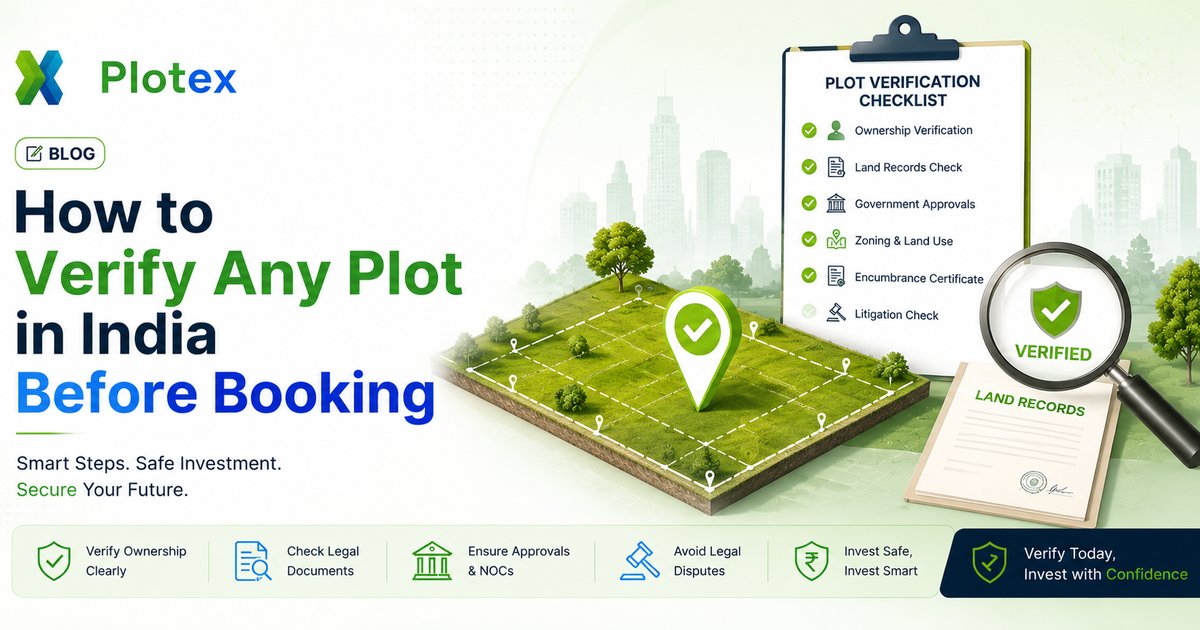
The single biggest mistake first-time plot buyers in India make is paying token money before verification — and the second biggest is treating "verification" as a casual check rather than a 9-point investigation. Plot fraud in India isn't always fake registration; more often it's a real plot with one missing approval, a hidden encumbrance, or dimensions that don't match the layout drawing.
This is the complete 9-point checklist to verify any plot in India before booking — applicable across all states, all authority types (HMDA, BMRDA, PMRDA, CMDA, JDA, LDA, AUDA, IDA, BDA, VMRDA, and others), and all plot sizes from 150 sq.yd to 1 acre.
Read this once. Use it for every plot. It will protect you from 95% of plot-purchase mistakes.
The 30-second summary: Verify (1) Title via 30-year EC, (2) Authority-approved layout, (3) RERA registration if developer-marketed, (4) Land conversion (NA / DTCP), (5) 7/12 / RTC / Pahani extract, (6) Mutation status, (7) Physical dimensions via 3D plot view, (8) No litigation / encumbrance, (9) Property tax payment up to date. Skip any one and you're exposed.
Point 1 — Title Verification via 30-Year Encumbrance Certificate
The Encumbrance Certificate (EC) is the foundation of plot verification. It's a state-issued document listing every registered transaction on the survey number over a specified period — sales, gifts, mortgages, court attachments, partition deeds.
For plot verification, always demand a 30-year EC, not 12 years. Why? Because 12 years is the limitation period under the Limitation Act for adverse possession claims, and the average plot in India has changed hands multiple times in the last 20 years.
- Where to get: State land-records portal (IGRS) — most states allow online EC download. Examples: igrs.telangana.gov.in, kaverionline.karnataka.gov.in, igrmaharashtra.gov.in, tnreginet.gov.in, ulpinrera.up.gov.in.
- What to look for: Continuous chain of ownership ending at the current seller. Any gaps, missing links, or unexplained transfers are red flags.
- If EC shows mortgage: Demand "No Dues Certificate" from the bank/lender before paying token.
Point 2 — Local Authority Layout Approval
Every legitimate plot in urban / peri-urban India sits inside a layout approved by a state development authority. The authority varies by city:
| City | Authority | Verify on |
|---|---|---|
| Hyderabad | HMDA | hmda.gov.in |
| Bengaluru | BMRDA / BIAPPA / DTCP | bmrda.karnataka.gov.in / dtcp.karnataka.gov.in |
| Pune | PMRDA | pmrda.gov.in |
| Chennai | CMDA / DTCP | cmdachennai.gov.in |
| Jaipur | JDA / RIICO | jda.urban.rajasthan.gov.in |
| Lucknow | LDA | ldaonline.co.in |
| Ahmedabad | AUDA | auda.org.in |
| Indore | IDA | idaindore.org |
| Bhubaneswar | BDA | bdabbsr.in |
| Vizag | VMRDA | vmrda.gov.in |
Pull the actual layout sanction PDF from the authority portal. Confirm:
- Sanction number matches the developer's claim.
- Sanctioned plot numbers match what the developer is selling.
- The sanctioned drawing shows all roads, open spaces, and amenities at correct dimensions.
Point 3 — RERA Registration Verification
If the plot is being sold by a developer (not a private owner), RERA registration is mandatory under the Real Estate (Regulation and Development) Act, 2016, for any layout selling 8 or more plots or covering area above 500 sq.m (limit varies by state).
State RERA portals to verify on:
- Maharashtra — maharera.maharashtra.gov.in
- Karnataka — rera.karnataka.gov.in
- Telangana — telangana.rera.gov.in
- Tamil Nadu — rera.tn.gov.in
- Gujarat — gujrera.gujarat.gov.in
- Uttar Pradesh — up-rera.in
- Rajasthan — rera.rajasthan.gov.in
- Andhra Pradesh — rera.ap.gov.in
- Odisha — rera.odisha.gov.in
- Madhya Pradesh — rera.mp.gov.in
On the RERA portal, check:
- Project status (Registered / Lapsed / De-registered).
- Registration validity dates.
- Approved layout PDF uploaded on the portal.
- Complaints filed against the developer.
- Quarterly progress reports.
"RERA applied" is not RERA registered. Walk away if the developer can only show an application number. For a deeper walkthrough of what RERA registration guarantees and how to read the portal records, see our RERA-approved plots guide.
Point 4 — Land Conversion Status (NA / DTCP)
In India, agricultural land cannot be sold for residential use without first being converted. The conversion is called NA conversion (Non-Agricultural) in most states, or DTCP (Directorate of Town and Country Planning) clearance in Karnataka and Tamil Nadu.
Demand the original NA / DTCP order. Verify:
- Order number and date.
- Survey numbers covered.
- Permitted land use (residential / commercial / mixed).
- Conditions attached (any pending compliance).
If the 7/12 extract still shows agricultural classification, the conversion either hasn't happened or hasn't been recorded — both are red flags.
Point 5 — 7/12 Extract / RTC / Pahani / Adangal
The village land record goes by different names across India:
- Maharashtra, Gujarat — 7/12 Utara (Satbara)
- Karnataka — RTC (Record of Rights, Tenancy, and Crops)
- Telangana, Andhra Pradesh — Pahani / 1B / Adangal
- Tamil Nadu — Adangal / Chitta
- Uttar Pradesh — Khatauni
- Rajasthan — Jamabandi
- Odisha — ROR (Record of Rights)
Pull the latest extract from the state's land-records portal and check:
- Owner's name matches the seller.
- Plot area matches the layout sanction.
- Classification (residential / agricultural).
- Any tenancy or loan entries (Other Rights column).
Point 6 — Mutation Status
Mutation is the process of updating municipal / revenue records to reflect the current owner. After every sale, the buyer must apply for mutation at the local panchayat or municipal corporation.
For the plot you're considering:
- If the seller bought the plot recently, ask for the mutation certificate in the seller's name.
- If mutation is still pending in the seller's name, you'll have to do it before re-selling — adds delay.
- For freshly developed layouts, mutation happens after authority sanction; verify the layout-level mutation.
Point 7 — Physical Dimension Verification via 3D Plot View
This is the verification step that 90% of buyers skip — and it's the one that prevents the most common post-purchase regret: discovering the plot isn't the shape, size, or position you thought.
A 3D plot view converts the authority-approved layout PDF into an interactive 3D model that loads in any browser. With it, you can:
- Rotate the entire layout 360° to see plot placement relative to roads.
- Click on individual plot numbers to verify exact dimensions.
- Confirm corner positioning (plots at intersections have higher value).
- Measure road widths abutting your specific plot.
- Verify proximity to amenities, open spaces, and main entry.
For NRI buyers and out-of-town investors, this is the most reliable remote-verification tool. If you're not yet comfortable interpreting a sanctioned layout drawing, start with our guide on how to read a land plot map, then read how to convert PDF maps to 3D plot visualization to see how the process works.
Point 8 — No Litigation, No Encumbrance, No Hidden Claims
Beyond the EC, do these checks:
- Court litigation search — Use the eCourts portal (ecourts.gov.in/ecourts_home) and search by seller's name and survey number. Any pending civil suit involving the property is a red flag.
- Bank loan / mortgage — The EC will show this; cross-verify with the seller's "No Dues" certificate from the bank.
- Family disputes — If the seller inherited the plot, ask for a partition deed signed by all legal heirs. Plots without partition deeds attract future claims from siblings or cousins.
- Income tax attachment — Some plots are attached under Income Tax Act recovery proceedings. The EC will reflect this.
Point 9 — Property Tax / Khata / Up-to-Date Payments
Demand receipts for the last 5 years of:
- Annual property tax to municipal corporation / panchayat.
- Layout maintenance / association fees if applicable.
- Land revenue payments.
Unpaid dues become your liability after registration. Some authorities also refuse mutation if tax dues exist.
For Karnataka specifically, demand the Khata certificate (A Khata is fully legitimate; B Khata has restricted re-construction rights and lower bank-loan eligibility).
Bonus — Google Earth Historical Imagery Check
Open Google Earth Pro (free) → search the plot coordinates → use the time slider to view the plot's history over the last 15-20 years. Watch for:
- Was this land a water body, wetland, or forest in the recent past?
- Was it encroached by structures that were later cleared?
- Is the current vegetation pattern consistent with claimed land use?
This costs you zero rupees and takes 10 minutes.
The Plot Verification Process — Recap Timeline
- Day 1-2: Order EC (30 years) and 7/12 / RTC / Pahani extract online.
- Day 2-3: Pull authority layout sanction PDF and verify on portal.
- Day 3-4: Verify RERA registration on state portal.
- Day 4-5: Demand NA / DTCP order, mutation certificate, property tax receipts.
- Day 5-7: Order 3D plot view to verify dimensions remotely.
- Day 7-10: Engage a local advocate for litigation search and final title opinion.
- Day 10-14: Site visit, finalise terms, pay token via cheque.
- Day 14-30: Sale deed registration, stamp duty payment, mutation application.
Two weeks of due diligence saves you 20 years of legal disputes.
What If You're Buying from a Resale Owner?
When the seller is an individual (not a developer), the verification is slightly different. Extra checks:
- Verify the original sale deed in the seller's name.
- If the plot is jointly held (husband-wife, family members), all co-owners must sign the sale deed.
- If the seller is NRI, verify their PAN and ensure TDS of 20-30% is deducted on payment (Section 195).
- Cross-check with the original layout sanction — sometimes resale plots have unauthorised internal subdivisions.
Bottom Line
The 9-point checklist isn't optional — it's the standard professional plot buyers use. The Encumbrance Certificate proves clean title, RERA registration ensures regulatory compliance, the authority sanction confirms legal layout, the 7/12 extract verifies ownership, and the 3D plot view confirms physical reality matches paper claims.
Whichever city you're buying in — Hyderabad, Bengaluru, Pune, Chennai, Jaipur, Lucknow, or anywhere else — the checklist is universal. See our city-level guides for authority-specific verification details, and our best cities to invest in plots in India 2026 guide for market-level context.
For known scams and warning signs that even pass standard verification, read our list of the 10 red flags before buying a plot.

Frequently Asked Questions
What is the most important document to verify before buying a plot in India?
The single most important document is the Encumbrance Certificate (EC) covering the last 30 years. It lists every registered transaction on the plot — sales, mortgages, gifts, court attachments — and is the definitive proof that the seller has clear title. Without a 30-year EC, you cannot confirm whether the plot is loan-free, dispute-free, or even legally owned by the seller. The EC is available online in most Indian states via the IGRS / land-records portal.
How do I check if a plot has RERA registration in India?
Visit your state RERA portal — for example maharera.maharashtra.gov.in for Maharashtra, rera.karnataka.gov.in for Karnataka, telangana.rera.gov.in for Telangana, rera.tn.gov.in for Tamil Nadu, jaipur.rera.rajasthan.gov.in for Rajasthan, up-rera.in for Uttar Pradesh, gujrera.gujarat.gov.in for Gujarat. Search by RERA registration number, project name, or developer name. The portal shows registration validity, approved project documents, complaint history, and quarterly compliance reports.
What is a 7/12 extract and why does it matter for plot verification?
The 7/12 extract (also called Satbara Utara in Maharashtra, RTC in Karnataka, Pahani in Telangana, Adangal in Tamil Nadu) is the village land record that shows the current owner, land area, crop pattern, and any tenancy or loan entries. For plot verification it confirms two things: (1) Who legally owns the survey number on government records, and (2) Whether the land is still classified as agricultural — meaning the conversion to non-agricultural (NA) status either hasn't happened or hasn't been recorded.
Can I verify a plot's dimensions and road access without visiting the site?
Yes, using a 3D plot view. By converting the authority-approved layout PDF into an interactive 3D model, buyers can rotate the layout, click individual plot numbers, verify exact dimensions, see road widths on each side, check corner positioning, and confirm that the plot they're being shown matches the layout drawing. This is especially valuable for NRI buyers, out-of-town investors, and any buyer who wants pre-visit verification.
What is mutation and is it mandatory after buying a plot in India?
Mutation is the process of updating the local revenue / municipal records to reflect the new owner after a sale deed is registered. While the sale deed legally transfers ownership, the property tax records, utility connections, and land-revenue books also need to be updated — that's mutation. Yes, it's mandatory. Without mutation, you may not be able to apply for building permissions, electricity / water connections, or eventually re-sell the plot smoothly.