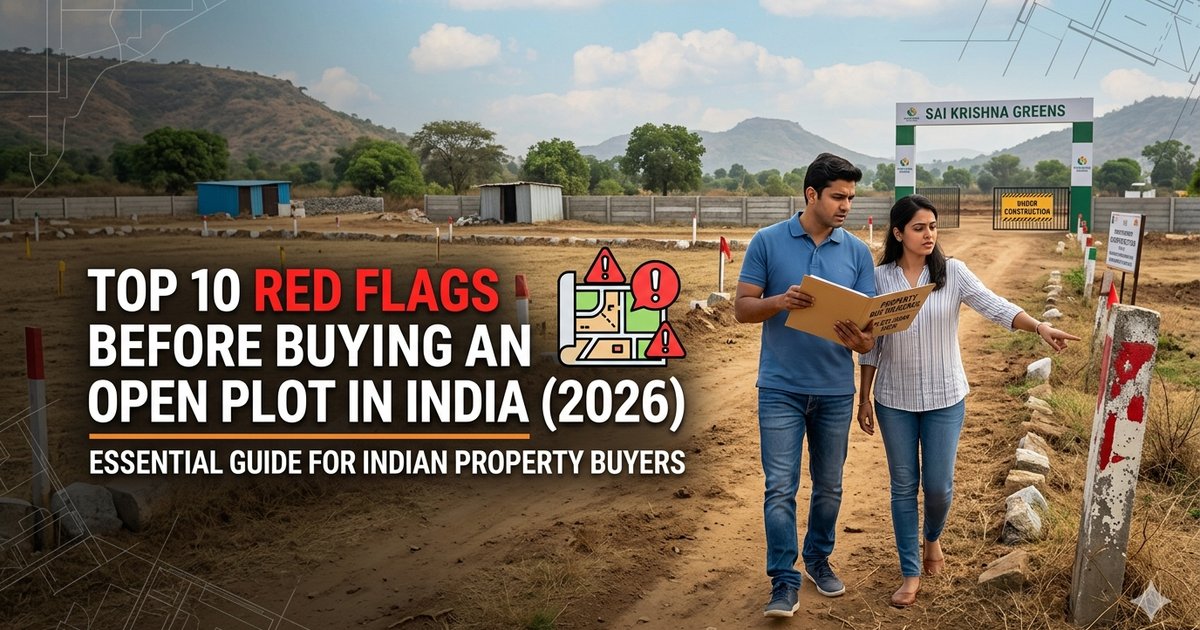
Every year in India, thousands of first-time plot buyers lose money on plots that looked perfectly legitimate on paper. The fraud isn't usually a fake registration — it's almost always a missing approval, a hidden encumbrance, or a layout that "applied" for RERA but never got it.
These are the top 10 red flags before buying an open plot in India — the warning signs that even disguised plot scams cannot hide. Read this once. Use it on every plot you shortlist. Don't pay a single rupee of token money before clearing all 10.
The most reliable filter: If the seller hesitates, delays, or refuses to provide any of these 10 documents, walk away. Legitimate plots pass every check easily. Sellers who push you to "pay first, papers later" are virtually always hiding something.
Red Flag 1 — "RERA Applied" Without Active Registration
⚠ The Scam
The developer claims the project is "RERA registered" or shows you a screenshot / brochure with a RERA number, but cannot point you to the live entry on the state RERA portal.
Why it's dangerous: A "RERA applied" or "RERA pending" project has no regulatory protection. If the application is rejected, you have no legal recourse to recover money paid for plots in that layout. Fraudsters often print fake RERA numbers on brochures that don't exist on the portal at all.
How to verify: Visit maharera.maharashtra.gov.in, rera.karnataka.gov.in, telangana.rera.gov.in, rera.tn.gov.in, gujrera.gujarat.gov.in, up-rera.in, or your state RERA portal. Search the registration number. The project must show as "Registered" with valid dates — not "Applied," "Lapsed," or "De-registered." For the full picture of what registration protects, read our guide to RERA-approved plots.
Red Flag 2 — No Authority-Stamped Layout PDF
⚠ The Scam
The developer shows you a glossy printed layout brochure or a forwarded PDF — but cannot provide the actual sanctioned layout downloaded directly from the development authority's portal (HMDA, BMRDA, PMRDA, CMDA, JDA, LDA, AUDA, IDA, BDA, VMRDA, DTCP).
Why it's dangerous: Layouts without authority sanction cannot be registered, cannot get construction permission, and cannot get water/electricity connections. The "approval" the developer mentions may be for a different survey number or may never have happened.
How to verify: Visit the authority's official portal, search by survey number or layout name, and download the sanctioned PDF yourself. The PDF must carry the authority's stamp, sanction number, and date. If the developer cannot direct you to the portal entry, the layout is illegal.
Red Flag 3 — Land Still Classified as Agricultural
⚠ The Scam
The seller claims NA (Non-Agricultural) conversion is "done" or "applied," but the latest 7/12 extract / RTC / Pahani still shows the land as agricultural.
Why it's dangerous: An agricultural plot sold for residential use is illegal. Even if a sale deed is registered, building permission will be denied and the property tax department may claim back-taxes. NRIs are explicitly prohibited from buying agricultural land without RBI permission.
How to verify: Pull the latest 7/12 extract (Maharashtra/Gujarat), RTC (Karnataka), Pahani (Telangana/AP), Adangal (Tamil Nadu), or Khatauni (UP) from the state land-records portal. Confirm the classification column reads "Non-Agricultural" or shows the NA conversion order number.
Red Flag 4 — Encumbrance Certificate Less Than 30 Years
⚠ The Scam
The seller provides only a 12-year or 15-year Encumbrance Certificate, claiming "that's enough."
Why it's dangerous: The Limitation Act allows certain adverse possession claims to surface 12-20 years after a transaction. A 12-year EC won't reveal disputed transfers from before that window. The minimum standard for safe plot purchase is a 30-year EC.
How to verify: Order a 30-year EC online from the state IGRS portal (it's a small fee, Rs 100-500). Examine every entry. Any gap, unexplained transfer, pending mortgage, or court attachment is a deal-breaker until resolved in writing.
Red Flag 5 — Gunthewari or Unapproved Subdivision Sold as PMRDA / Authority-Approved
⚠ The Scam
(Maharashtra-specific but pattern repeats elsewhere): The developer markets a "PMRDA plot" that is actually a gunthewari (regularised unauthorized subdivision) or a layout never sanctioned by the authority. In Karnataka, similar plots are sold as "B Khata" claiming equivalence to "A Khata."
Why it's dangerous: Gunthewari and B Khata plots have restricted construction permissions, lower bank loan eligibility, narrower resale market, and unpredictable future regulatory risk. They're not the same legal class as fully approved plots.
How to verify: Demand the original PMRDA / authority sanction document from the developer. Cross-check on the authority's portal. In Karnataka, demand the A Khata certificate, not B Khata. If the developer cannot produce these, walk away.
Red Flag 6 — Survey Number Mismatch Between Documents
⚠ The Scam
The survey number on the sale deed, 7/12 extract, layout approval, and RERA registration don't all match. Some documents show one survey number; others show a different one or a vague combination.
Why it's dangerous: Plots sold this way often turn out to be on land the developer doesn't own, or on land where ownership is disputed between multiple parties. Title transfer becomes impossible without litigation.
How to verify: Cross-reference all four documents — sale deed, 7/12/RTC/Pahani, authority approval, RERA registration. Every survey number must match exactly. If the developer says "the survey number changed after consolidation," demand the consolidation order in writing.
Red Flag 7 — Vague or Undefined Plot Boundaries
⚠ The Scam
The plot's exact boundaries are described in vague terms like "near the road," "next to plot 47," or "approximately 1,200 sq.ft." Compound walls or visible markers don't define the plot's edges.
Why it's dangerous: Without exact boundaries fixed on the approved layout, neighbouring plot owners may encroach over time, or the developer may shift the plot during registration. Disputes can drag on for years.
How to verify: Demand the approved layout drawing with your plot's exact dimensions and survey number markings. Walk the plot with the developer and a measuring tape — confirm every boundary matches the drawing. A 3D plot view is the modern way to verify this remotely — read our 9-point verification guide.
Red Flag 8 — Property Tax / Land Revenue Not Paid for Years
⚠ The Scam
The seller cannot produce the last 5 years of property tax receipts or land revenue payments — or admits they're "behind by a year or two."
Why it's dangerous: Unpaid property tax becomes your liability after registration. Some municipalities refuse mutation until back-taxes are cleared. Worse, large unpaid amounts can trigger municipal attachment proceedings.
How to verify: Demand original receipts for the last 5 years of property tax. Cross-check via the municipal corporation / panchayat online portal. If the seller is willing to clear back-taxes before registration, get it in writing as a condition of sale.
Red Flag 9 — Hidden Bank Mortgage or Income Tax Attachment
⚠ The Scam
The 30-year Encumbrance Certificate shows a bank mortgage, court attachment, or income tax recovery against the plot — but the seller insists "it will be cleared at registration."
Why it's dangerous: If the seller's promise fails, the bank or government can take over the plot regardless of who's currently registered as owner. Your money is lost.
How to verify: Demand a "No Dues Certificate" from the bank or institution holding the lien, dated within 30 days of the sale. The certificate must explicitly clear the survey number and plot in question. Pay no token money until this is in your hand.
Red Flag 10 — Cash-Heavy Transaction Demands
⚠ The Scam
The seller / developer pushes for a large cash payment (often "discount" or "registry savings") or insists the registered price be far lower than the actual price.
Why it's dangerous: Section 269ST of the Income Tax Act voids cash plot transactions above Rs 20,000. Under-registration (calling the plot Rs 30 lakh when you paid Rs 50 lakh) attracts capital gains issues, GST scrutiny, and potential criminal charges. NRIs face additional FEMA penalties for cash payments.
How to verify: Insist that the full sale consideration is registered. Pay everything via banking channels — cheque, NEFT, RTGS, or NRE/NRO transfer for NRIs. The "savings" from cash transactions almost always come with delayed, expensive consequences.
Bonus Red Flags Worth Noting
- Plot photos look stitched or angle-manipulated: Always demand current drone footage or visit yourself.
- Multiple brokers selling the same plot: Inventory should be tightly controlled. Multiple sellers means weak inventory control.
- "Bulk booking discount" pressure: Real estate fraud frequently uses urgency tactics like "10 plots being booked today."
- Plot location on the layout differs in PDF vs site: A 3D plot view exposes this immediately. PDFs can hide it.
- Plots in notified water bodies or forest areas: Check Google Earth historical imagery — if the plot was a lake in 2010, it may still be on the "blue zone" map.
- "Spot booking" without RERA-compliant booking form: All RERA bookings need a formal Allotment Letter. A handwritten receipt is not enough.
How to Spot All 10 in One Sitting
Before you visit a plot, complete this checklist — it pairs perfectly with our step-by-step guide on how to verify a plot before buying:
- Pull RERA entry from state portal.
- Pull authority layout PDF from authority portal.
- Pull 30-year EC from IGRS.
- Pull latest 7/12 / RTC / Pahani / Adangal.
- Cross-match survey numbers across all four.
- Order property tax receipts for last 5 years.
- Run litigation search on eCourts portal.
- Order an interactive 3D plot view to verify dimensions remotely.
This takes 7-14 days end-to-end. It saves you 20 years of legal disputes if any of these turn up dirty.
How 3D Plot View Helps Spot Red Flags
A 3D plot view is uniquely useful for spotting Red Flag 7 (vague boundaries) and Red Flag 2 (missing authority approval). It exposes:
- Dimension mismatches between the marketed PDF and the approved layout.
- Internal road widths that were claimed as 9 metres but are actually 6 metres.
- Missing amenities promised in the brochure but absent from the sanctioned layout.
- Corner-plot premiums charged for non-corner positions.
- Plot orientation discrepancies that affect Vastu (see our Vastu rules for an open plot).
For NRI and out-of-city plot buyers, the 3D view is the single most powerful red-flag detector you can use without flying to the site. Read more in our guide on why builders are switching from PDFs to 3D.
What to Do If You Already Paid Token on a Suspicious Plot
If you've paid token money and discovered one of these red flags after, immediately:
- Stop further payments. Inform the developer in writing.
- Demand a refund of token money under the Sale Agreement clauses.
- If the developer refuses, file a RERA complaint (state RERA tribunals handle these).
- Consult a real estate advocate for sale agreement termination.
- Report fraud to local police if the layout is fully unauthorized.
- Inform other buyers in the layout — collective action is more effective.
The Bottom Line
Red flags before buying an open plot in India are almost always paperwork-based, not site-based. The plot will look beautiful, the developer will sound convincing, but the documents will tell the real story. RERA registration, authority approval, NA conversion, 30-year EC, property tax receipts, no-dues certificates — these are non-negotiable.
Add a 3D plot view to the verification stack and you'll catch the dimension and layout discrepancies that even paper checks miss. Combined with our 9-point plot verification checklist, the chance of buying a problematic plot drops to under 5%.
Once you've cleared all 10 red flags, you're ready to negotiate price, finalize the plot, and book a site visit. For city-level investment context, see our best cities to invest in plots in India 2026 and plot vs flat investment guides.

Frequently Asked Questions
What is the biggest red flag when buying an open plot in India?
The single biggest red flag is a seller who refuses to share the authority-stamped approved layout PDF from the development authority's portal (HMDA, BMRDA, PMRDA, CMDA, JDA, LDA, AUDA, etc.). 'RERA applied,' 'sanction expected,' or photocopied/forwarded layout drawings are not equivalent to actual sanctioned layouts.
How do I spot a fake RERA registration on a plot project?
Always cross-check the RERA number on the official state RERA portal — never trust a screenshot, brochure photo, or WhatsApp PDF. Visit maharera.maharashtra.gov.in, rera.karnataka.gov.in, telangana.rera.gov.in, gujrera.gujarat.gov.in, up-rera.in, and similar portals for your state. 'RERA applied' or 'under registration' is not RERA registered.
What is a gunthewari plot and why is it risky?
Gunthewari is a Maharashtra-specific regularization scheme for unauthorized plot subdivisions. Gunthewari plots are technically not the same as PMRDA / authority-approved plots — they were subdivided without sanction and later regularized. The risk: gunthewari status doesn't guarantee proper road widths, drainage, FSI, or future construction permissions. Banks are reluctant to lend on gunthewari plots.
How can I verify a plot's title clearly before buying?
Order a 30-year Encumbrance Certificate (EC) from the state IGRS / land-records portal, not just a 12-year EC. The 30-year EC shows every registered transaction — sales, mortgages, gifts, court attachments. Cross-check the latest 7/12 extract (or RTC/Pahani in your state) to confirm the seller's name matches government records. Hire an independent advocate (not the developer's lawyer) for a formal title opinion.
Why should I use a 3D plot view to spot red flags before buying?
A 3D plot view reveals dimension and layout mismatches that flat PDFs can hide. Common red flags spotted via 3D include plot dimensions that don't match the actual layout shape, internal road widths claimed as 9 metres but actually 6 metres, corner plot premium charged for a non-corner position, and missing amenities marketed in the brochure. The 3D view lets remote and NRI buyers verify without flying down.