"Plot lo ya flat?" is the single most-asked question by first-time Indian real-estate investors. The internet's answer is usually one of two clichés — "land never goes down" or "flats give rental income." Neither is wrong. Neither is a strategy.
This guide is the data-backed comparison of plot vs flat investment in India 2026 across the seven parameters that actually decide your wealth outcome over the next 7-15 years: capital appreciation, rental yield, total ROI, tax benefits, loan eligibility, liquidity, and risk.
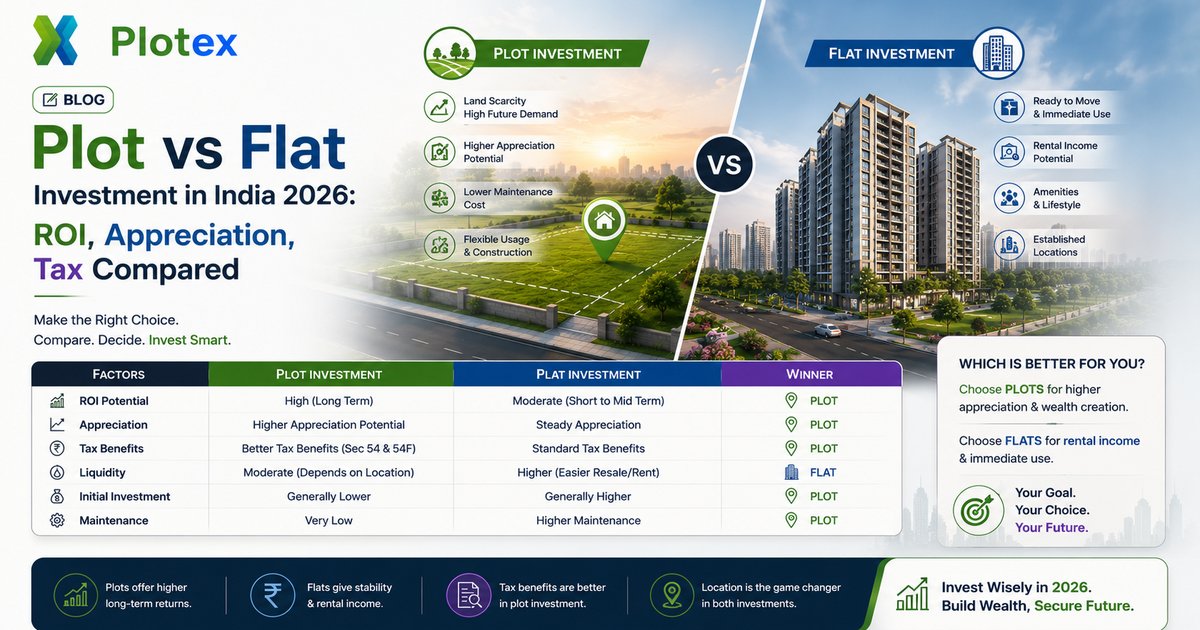
Quick answer: For long-term wealth building (7+ years), plots win on capital appreciation by 8-14 percentage points annually. For income generation (rental cash-flow), flats win decisively. For a balanced portfolio, plots in growth corridors + a flat in a rental-friendly metro = the ideal combination if your budget allows both.
The Fundamental Difference — Why Plot and Flat Behave Differently
A plot is land. Land is a finite asset that doesn't depreciate. The supply of land in any growth corridor — Devanahalli, Wagholi, Shadnagar, OMR — is fixed forever.
A flat is land + a building. The land underneath your flat is shared across all owners (your "undivided share" is a tiny fraction). The building component depreciates — every year, the structure loses 1-2% of its value due to wear, ageing materials, and obsolescence. After 30 years, a typical flat's structure is functionally outdated.
This single difference drives most of the long-term divergence between plot and flat returns.
Parameter 1 — Capital Appreciation
Plot Appreciation
Plot appreciation in Indian growth corridors over the last 5 years has averaged:
- Hyderabad HMDA outskirts: 18-22% CAGR.
- Bengaluru Devanahalli / Sarjapur: 14-17% CAGR.
- Pune Wagholi / Talegaon: 13-15% CAGR.
- Chennai OMR / ECR: 12-14% CAGR.
- Jaipur JDA / Tonk Rd: 11-14% CAGR.
- Tier-2 (Indore, Lucknow, Bhubaneswar): 10-13% CAGR.
Flat Appreciation
Flat appreciation in the same cities:
- Premium gated communities in metros: 7-12% CAGR.
- Mid-tier apartments: 5-8% CAGR.
- Affordable housing: 3-6% CAGR.
- Older apartments (10+ years): 2-4% CAGR (sometimes flat or negative).
Verdict on appreciation: Plots win by a wide margin in growth corridors. Flat appreciation only matches plot appreciation in luxury / premium gated communities in mature markets.
For city-level data and corridor recommendations, see our guide to the best cities to invest in plots in India 2026.
Parameter 2 — Rental Yield
This is where flats decisively win.
Flat Rental Yield
- Bengaluru (Whitefield, Sarjapur): 3.5-4.5% annually.
- Hyderabad (Kondapur, HITEC City): 3-4%.
- Pune (Hinjewadi, Kharadi): 3-4%.
- Mumbai (mid-city): 2-3%.
- NCR (Gurgaon Cyber City): 3-4%.
- Chennai (OMR): 3-3.5%.
Plot Rental Yield
- Raw residential plots: 0.5-1.5% (rare; usually fenced compound for events / storage).
- Commercial plots in urban locations: 3-6%.
- Agricultural / horticultural plots: 1-3% (crop cycles).
- Advertising hoarding rentals: 2-4% on premium-location plots.
Verdict on rental yield: Flats clearly win for residential rental cash flow. Commercial plots can compete but are a different asset class entirely.
Parameter 3 — Total ROI (Appreciation + Yield)
Combining appreciation and rental yield for a 10-year holding period (assuming average corridor for each):
| Asset | Appreciation CAGR | Rental Yield | Total Annual ROI | 10-year Wealth Multiplier |
|---|---|---|---|---|
| Plot in growth corridor | 14% | 0.5% | 14.5% | ~3.87x |
| Flat — premium gated | 9% | 3.5% | 12.5% | ~3.25x |
| Flat — mid-tier | 6% | 3.0% | 9.0% | ~2.37x |
| Plot — tier-2 city | 11% | 0.5% | 11.5% | ~2.97x |
For a 10-year horizon, plots in growth corridors typically deliver ~20% more total wealth multiplier than mid-tier flats and ~16-19% more than premium gated flats. The gap widens further over 15-20 years because rental yield is reinvested at flat returns while plot appreciation continues compounding on raw land.
Parameter 4 — Tax Treatment
Tax is where flats have a structural advantage during the investment period.
Flat Tax Benefits
- Section 80C: Principal repayment up to Rs 1.5 lakh/year deductible.
- Section 24(b): Home loan interest up to Rs 2 lakh/year (self-occupied) or full interest (let-out).
- Rental income: 30% standard deduction under Section 24(a) before income tax.
- Section 80EEA (affordable housing): Additional Rs 1.5 lakh interest deduction (conditional).
Plot Tax Treatment
- No tax benefit on plot loan interest until construction starts.
- No Section 80C benefit on plot loan principal.
- Property tax paid is deductible only if rental income is shown.
- Capital gains on plot sale: 20% LTCG with indexation (if held > 24 months).
Verdict on tax: Flats win during the holding period. On sale, both attract similar LTCG rates with indexation.
For complete plot loan tax treatment and conversion to home loan after construction, see our plot loan eligibility guide for SBI, HDFC and ICICI.
Parameter 5 — Loan Eligibility
| Parameter | Plot Loan | Home Loan (Flat) |
|---|---|---|
| Max LTV | 70-75% | 80-90% |
| Max tenure | 10-15 years | 20-30 years |
| Interest rate | 9.0-11.5% | 8.4-10.5% |
| Construction condition | 2-5 years | N/A |
| Tax benefit during loan | None | Full |
Verdict on loans: Flats are significantly more loan-friendly. You can buy a higher-value flat with less equity than a plot of similar value.
Parameter 6 — Liquidity (How Easy to Sell)
Flat Liquidity
Flats in metros and large tier-2 cities have deep secondary markets. End-users (people who want to live there) are a much larger buyer base than investors. Average flat resale timeline: 3-9 months.
Plot Liquidity
Plots historically had thinner secondary markets — fewer buyers, longer search timelines. But this has changed in growth corridors:
- HMDA Shadnagar plots: 4-8 months to resell.
- Devanahalli plots: 6-10 months.
- Wagholi PMRDA plots: 4-8 months.
- Tier-3 city plots: 12-24 months.
The 3D plot view changes this equation significantly. Modern plot resales close 30-50% faster when an interactive 3D view is available, because NRI and out-of-city buyers can verify remotely without flying in. Plot liquidity in 2026 is much closer to flat liquidity than it was in 2020.
For more on why builders and brokers are switching to 3D plot views, see our switching from PDFs to 3D guide.
Parameter 7 — Risk Profile
Flat Risks
- Building depreciation (1-2% per year).
- Maintenance disputes with association.
- Builder delays for under-construction flats.
- Forced redevelopment after 30-40 years.
- RERA timeline overruns.
Plot Risks
- Illegal layouts (unapproved subdivisions).
- Title disputes (especially in inherited / partition plots).
- Land-use reclassification (residential to road / public use).
- Encroachment if plot is unfenced and remote.
- NA conversion not done / not recorded.
Plot risks are mostly pre-purchase — manageable with proper due diligence. Flat risks are mostly during-purchase (developer trust) and long-term (building age). Use our 9-point plot verification checklist and red flags list to mitigate plot-specific risks before booking.
The 10-Year Wealth Scenario — Real Numbers
Assume you have Rs 25 lakh to invest. Compare three options:
| Option | Asset | 10-Yr Value | Rental (Total 10 yrs) | Total Wealth |
|---|---|---|---|---|
| A | Plot in Hyderabad (HMDA Shadnagar) | ~Rs 96 lakh | ~Rs 1.5 lakh | ~Rs 97.5 lakh |
| B | Premium Flat in Bengaluru (Whitefield) | ~Rs 59 lakh | ~Rs 11 lakh | ~Rs 70 lakh |
| C | Mid-tier Flat in Pune (Wakad) | ~Rs 45 lakh | ~Rs 8 lakh | ~Rs 53 lakh |
(Numbers approximate — assume 14% plot CAGR, 9% premium flat CAGR + 3.5% rent, 6% mid-tier flat CAGR + 3% rent. Property tax, maintenance, and tax adjustments excluded for simplicity.)
The plot wins on absolute wealth multiplier. The flat wins on monthly cash-flow during the holding period.
When Should You Choose a Plot?
- Investment horizon is 7+ years.
- You don't need monthly rental income from this asset.
- You want maximum capital appreciation.
- You can afford the lower LTV (need more equity upfront).
- You plan to build a house on it in 3-5 years (unlocks tax benefits).
- You're targeting a growth corridor in Hyderabad, Bengaluru, Pune, Chennai, Jaipur, Lucknow, etc.
- You're an NRI looking for inflation-beating wealth growth in India.
When Should You Choose a Flat?
- You need rental cash-flow.
- Investment horizon is 5-10 years.
- You prefer hands-off investing (flats have managed amenities).
- You're maxing out home loan tax benefits.
- You're buying in a city where plot supply is scarce (e.g. core Mumbai, central Delhi).
- You want lower entry barrier (higher LTV, longer tenure on home loans).
- You're targeting a premium gated community in a mature corridor.
The Hybrid Strategy — Plot + Flat
If your budget allows, the optimal Indian real estate portfolio combines both:
- 1 plot in a growth corridor for capital appreciation (Hyderabad / Bengaluru / Pune).
- 1 flat in a rental-friendly city for monthly cash-flow (Bengaluru / Hyderabad / Pune IT belts).
This combination captures both wealth multipliers — land appreciation on the plot side, rental income on the flat side — and diversifies across asset types within the same broad asset class.
NRI Special Consideration — Plot Almost Always Wins
For NRI investors specifically, plots in Indian growth corridors typically beat flats because:
- NRIs don't need the monthly rental for living expenses (already earning abroad).
- Plot appreciation is higher and INR-denominated, hedging against rupee weakness.
- Lower maintenance burden (no association issues, no tenants to manage).
- Easier to sell remotely if 3D plot view exists.
- Wealth-multiplication horizon (10-20 years) suits NRI repatriation timelines.
See our NRI plot investment in India 2026 guide for the complete NRI angle.
The Bottom Line
Plot vs flat investment in India 2026 comes down to two questions: What's your investment horizon? Do you need rental income?
For long-term wealth building (7+ years) without rental dependency, plots in growth corridors are mathematically superior — 12-22% appreciation CAGR vs 4-12% for flats. For rental cash-flow within 5-10 years, flats remain irreplaceable.
The single biggest decision is choosing the right plot, in the right corridor, with the right approvals. Use our top 10 cities ranking, 9-point verification, and red flags list to make sure your plot purchase delivers the appreciation it promises.
And always — always — get a 3D plot view before you sign. It's the single highest-impact verification tool for plot investors in 2026.

Frequently Asked Questions
Is investing in plots better than flats in India 2026?
For long-term wealth building (7+ years), plots typically outperform flats in India because land doesn't depreciate while built structures do. Plot appreciation averages 12-18% annually in growth corridors versus 4-8% for apartments. However, flats deliver 2-4% annual rental yield that plots cannot. The right choice depends on your investment horizon, cash-flow needs, and target city.
What is the appreciation rate of plots vs flats in India?
Plot appreciation rates in Indian growth corridors typically range from 12-22% annually, with Hyderabad outskirts, Bengaluru periphery, and Pune leading at 14-18% CAGR over the last 5 years. Flat appreciation averages 4-8% annually, with premium gated communities sometimes reaching 10-12%. The gap is structural — land is finite and doesn't depreciate, whereas buildings lose 1-2% structural value per year.
Can you get rental income from a plot in India?
Yes, but it's modest compared to flat rental. Raw plots can be leased for commercial parking, agricultural use, advertising hoardings, construction material storage, or as a fenced compound. Typical plot rental yields are 0.5-1.5% annually versus 2-4% for flats. The exception is commercial plots in urban locations, which can deliver 3-6% rental yield.
Do flats offer better tax benefits than plots in India?
Yes. Flat purchases unlock full home-loan tax benefits — Section 80C deduction up to Rs 1.5 lakh on principal, Section 24(b) deduction up to Rs 2 lakh on interest. Plot purchases unlock zero tax benefits until you complete construction. This makes plots tax-inefficient as a pure investment but neutral once construction begins.
Which is easier to sell — a plot or a flat?
Flats are generally easier to sell in metros because of higher buyer base. Plots have a narrower buyer base but in growth corridors like HMDA Shadnagar, Devanahalli, Wagholi, and Sanand, plot liquidity is excellent. A 3D plot view dramatically improves plot resale liquidity by letting remote buyers verify before negotiating. For pure liquidity in non-corridor locations, flats still hold an edge.