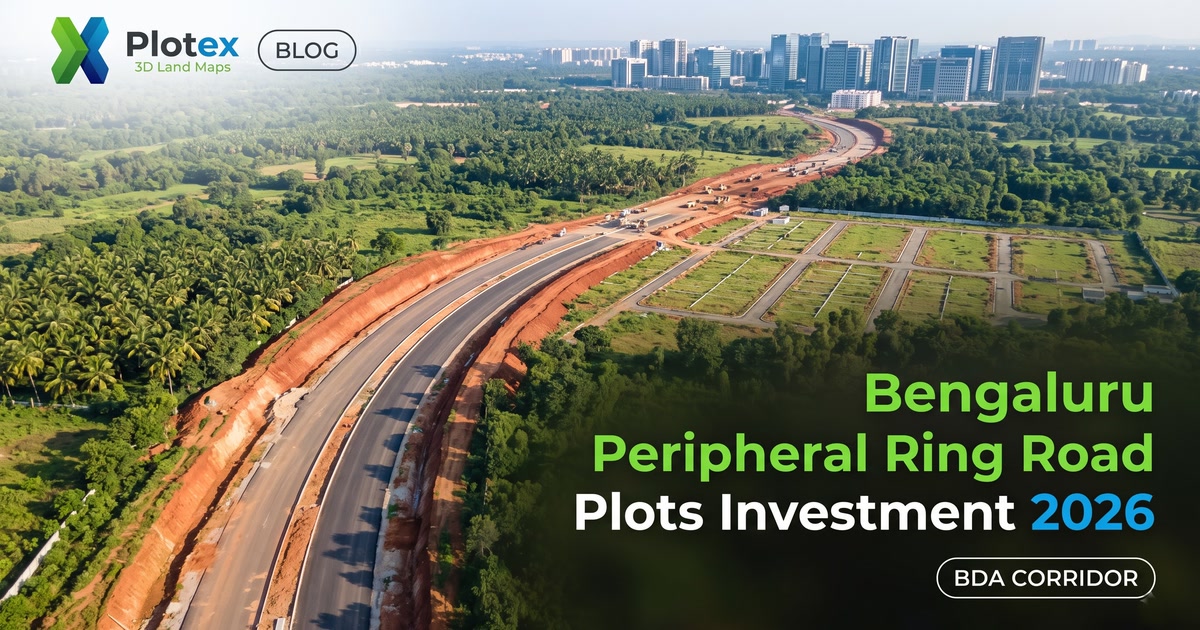
Bengaluru's Peripheral Ring Road has been talked about for so long that a whole generation of plot buyers has learned to discount it. That scepticism was earned — the project sat in litigation and funding limbo for years. What makes 2026 worth a fresh look is that the state changed its approach: instead of a single take-it-or-leave-it compensation rate, landowners are now being offered a menu of options — cash benchmarked to guidance value, transferable development rights, or a share of developed land — and hundreds have consented as a result.
That is a meaningful shift, but it is not completion. This guide is written for someone actually considering a plot on this corridor: what the PRR is in 2026, where the plotting activity really sits, and — most importantly for Bengaluru — the Khata and conversion documentation that decides whether a plot is a home site or a permanently frozen asset. Bengaluru punishes documentation shortcuts more harshly than almost any other Indian plot market, and a hyped corridor is exactly where those shortcuts get sold.
Quick takeaway: The PRR — rebranded the Bengaluru Business Corridor — is a ~73 km, ~₹27,000 crore BDA project needing roughly 2,560 acres. In 2026 it is in acquisition and consent, not construction, so price it as a probability rather than a certainty. The corridor's real danger for buyers is not the road slipping; it is a B-Khata or unconverted plot sold at a "corridor discount." Confirm Khata category, DC conversion, layout approval and K-RERA before any payment.
What the PRR Actually Is in 2026
The Peripheral Ring Road is a roughly 73 km corridor planned by the BDA to link Tumakuru Road in the north-west to Hosur Road in the south-east, arcing around the eastern side of the city and relieving the Outer Ring Road. Reported costs sit in the region of ₹27,000 crore, with land requirement around 2,560 acres. It has been rebranded the Bengaluru Business Corridor, partly to reflect the intent that it carries development, not just traffic.
The status in 2026 is genuinely mixed, and you should hold both halves of it at once. On the positive side: the state cabinet approved enhanced compensation, the flexible-options approach has unlocked consent from a large number of landowners, and the project has a level of political backing it lacked for a decade. On the other: negotiations with farmers on several stretches remain unresolved, land acquisition on a corridor this size is measured in years, and no meaningful construction timeline should be treated as fixed.
For a plot buyer, the practical translation is this. The PRR is a credible but unfinished catalyst. It deserves a place in your reasoning; it does not deserve the premium that a seller will attach to it. If a plot only makes financial sense assuming the road opens on schedule, you are not investing in land — you are taking a leveraged position on a government timetable.
Understanding the Compensation Options
The three-way compensation choice matters to you as a buyer even though you are not the one being compensated, because it shapes who owns what along the corridor:
- Cash at a multiple of guidance value. The owner exits. The land becomes state-held road corridor. Nothing there is available to buy.
- Transferable Development Rights (TDR). The owner surrenders land and receives development rights usable elsewhere in the city. This can put TDR-backed inventory into the market in areas away from the corridor.
- A share of developed land. The owner retains a stake and receives serviced land back once development happens. This is the option most likely to produce genuine future plot inventory near the corridor — and the one with the longest wait.
If you are being offered a plot by someone whose holding was partly acquired, ask which option they took and see the documentation. An owner who took cash for a portion has a very different residual interest from one awaiting developed land, and the paperwork you need differs accordingly.
Where the Plotting Activity Actually Is
| Belt | Character | Dependence on PRR |
|---|---|---|
| Devanahalli / north (Ballari Rd) | Airport-driven, established demand | Low — grows regardless |
| Tumakuru Road side | Industrial + affordable plotting | Moderate |
| Old Madras Rd / Whitefield east | IT-led, mature rates | Moderate |
| Sarjapur / Hosur Rd south-east | Strong IT demand, premium | Moderate |
| Pure mid-corridor stretches | Farmland, speculative pricing | High — the risky end |
The column that matters is the last one. North Bengaluru around Devanahalli is the clearest example of low dependence — the airport, the aerospace and hardware parks, and the business-district development there generate demand whether or not the PRR ever opens. That makes it expensive, but the price is buying you a catalyst that has already arrived. Our North Bengaluru plots guide covers that belt in detail.
At the other end, the mid-corridor stretches that are farmland today and are priced on the road are where the largest gains and the largest losses both live. There is nothing wrong with taking that bet deliberately. There is a great deal wrong with taking it while believing you have bought something safe.
The Bengaluru Documentation Trap — Khata, Conversion, e-Khata
This is the section that matters most, and it is specific to Karnataka.
A-Khata vs B-Khata
The Khata is the local body's record of a property for assessment purposes, and Bengaluru buyers have long distinguished two categories. A-Khata means the property is recorded as fully compliant: building plan sanction, bank finance and clean resale are all realistically available. B-Khata historically denoted properties recorded separately because of a deficiency — an unapproved layout, missing conversion, or unpaid dues — and those properties face real obstacles on sanction, lending and resale.
On a hyped corridor, B-Khata plots are precisely what gets pushed hardest, because they are the ones available at prices that feel like an opportunity. They are usually not. A plot you cannot get a plan sanctioned on, cannot finance, and cannot easily resell is not a discount — it is an illiquid holding with an uncertain regularisation path. Karnataka has moved to tighten and digitise this record through e-Khata, which makes verification easier than it used to be, so there is no excuse for skipping the check.
DC conversion
Agricultural land in Karnataka must be converted to non-agricultural use through a DC conversion order before it can lawfully be used for residential building — unless the plot sits inside an approved layout where conversion was handled at layout level. Corridor plots are frequently sold as "conversion applied for," and an application receipt gets waved as though it were an order. It is not. Ask to see the conversion order referencing your survey number, alongside the layout approval. Our guide on NA plot vs agricultural land explains why this single document decides whether you can ever build.
How to Verify a Bengaluru PRR Plot
1. Confirm the Khata category and pull the e-Khata
Establish whether the property is A-Khata and pull the digital e-Khata record. If it is B-Khata, understand exactly what the deficiency is and what regularisation would actually require before you consider the price attractive.
2. Get the current RTC (Pahani)
Pull the RTC / Pahani for the survey number to confirm ownership, extent and land classification, and to surface any charges or notes on the record.
3. See the DC conversion order
Ask for the actual DC conversion order for the survey number, or the approved layout under which conversion was granted. An application is not an approval.
4. Obtain an encumbrance certificate
Get the EC covering an adequate period to confirm the title is free of mortgages, charges and disputed transactions.
5. Verify layout approval and K-RERA
Confirm the layout approval from the BDA or the relevant planning authority, and check K-RERA registration for any developer-marketed project. (See our RERA-approved plots guide.)
6. Match the plot to the approved layout
On site, confirm the plot number, dimensions, road frontage and neighbours against the approved layout plan — not the brochure. Approved plans bind; marketing material does not.
Where 3D Plot Visualization Helps
Bengaluru's plot market is unusually remote-buyer heavy. A large share of demand comes from IT professionals posted in other cities, and from NRIs buying through relatives who can visit once, maybe twice. Those buyers do their legal diligence reasonably well and then stumble on the final, deceptively simple step: confirming that the specific plot they are paying for is the plot shown on the approved layout.
An interactive 3D plot view takes a flat approved-layout or survey PDF and turns it into something a buyer can actually navigate — each plot carrying its number, dimensions, road frontage and neighbours, viewable from a phone anywhere in the world. It is not a substitute for the Khata check or the conversion order. It is what makes the last mile — "is this the plot on the sanctioned plan?" — answerable without another flight. If you sell plots on this corridor, our Bengaluru plot layout page shows the format.

The Bottom Line
The Peripheral Ring Road is in a better position than at any point in its long history, and the flexible compensation approach is a genuine reason to take it more seriously in 2026 than in 2020. But it is still a corridor in acquisition, with unresolved stretches, and the honest way to price it is as a probability weighted over years — not as a road that is coming.
What should actually drive your decision in Bengaluru is documentation, because that is where money is lost here far more often than on infrastructure timing. A-Khata over B-Khata. A conversion order, not an application. An approved layout, not a brochure. K-RERA registration for anything developer-marketed. Get those right and a corridor plot is a reasonable long-horizon holding. Get them wrong and no amount of road-building will make the plot sellable.
Frequently Asked Questions
What is the Bengaluru Peripheral Ring Road and what is its status in 2026?
The Peripheral Ring Road (PRR) is a roughly 73 km, eight-lane corridor planned by the BDA to connect Tumakuru Road in the north-west to Hosur Road in the south-east, skirting east Bengaluru. It has been rebranded the Bengaluru Business Corridor and is reported at a cost in the region of ₹27,000 crore, requiring about 2,560 acres of land. As of 2026 the project is in the land-acquisition and consent-gathering stage — the state has approved enhanced compensation and hundreds of landowners have consented, but negotiations with farmers on some stretches are still unresolved, so treat the timeline as uncertain.
What compensation are landowners being offered for the PRR?
The state has approved a menu of options rather than a single rate, which typically includes a cash payout benchmarked at a multiple of the guidance value, transferable development rights (TDR) issued against the land value, or a share of developed land. The intent of offering choices is to reduce the litigation that stalled the project for years. If you are buying a plot from someone whose land was partly acquired, understand which option they took — a TDR-compensated owner and a cash-compensated owner have very different remaining interests in the land.
What is the difference between A-Khata and B-Khata, and why does it matter for a PRR plot?
A-Khata means the property is recorded as fully legal and compliant with the local body's requirements, so building plan sanction, bank loans and clean resale are available. B-Khata historically denoted properties recorded separately because of some deficiency — unapproved layout, missing conversion or unpaid dues — and those properties face serious obstacles on sanction, lending and resale. On a hyped corridor, B-Khata plots are exactly what gets pushed at attractive prices. Always confirm the Khata category, and remember that a low price on a corridor plot usually reflects a documentation problem rather than a bargain.
Do I need DC conversion for a plot near the Peripheral Ring Road?
Yes, unless the plot sits inside an already-approved layout where conversion was done at layout level. Agricultural land in Karnataka must be converted to non-agricultural use through a DC conversion order before it can lawfully be used for residential building. Many corridor plots are sold as 'converted soon' or on the strength of an application receipt. An application is not an order — ask to see the actual conversion order referencing your survey number, alongside the layout approval.
Which areas along the PRR corridor are seeing plot activity?
Activity clusters around the corridor's junctions with the existing radial highways — the Tumakuru Road and Ballari Road side in the north, the Old Madras Road and Whitefield side in the east, and the Sarjapur and Hosur Road side in the south-east. North Bengaluru around Devanahalli has its own independent airport-driven demand, which makes it less dependent on the PRR actually completing. Nodes that rely purely on the PRR are the higher-risk, higher-upside end of the corridor.
How do I verify a Bengaluru plot before booking it?
Check the Khata category and pull the e-Khata record, get the current RTC (Pahani) for the survey number, confirm the DC conversion order, obtain an encumbrance certificate covering an adequate period, and verify the layout approval from the BDA or the relevant planning authority. For any developer-marketed project, check K-RERA registration. Then match the plot on the ground — number, dimensions, road frontage — against the approved layout plan rather than the brochure. A 3D plot view makes that comparison much easier for remote and NRI buyers.
Disclaimer: This article is general information only and is not legal, financial or investment advice. Project scope, costs, alignments, compensation terms and timelines change and vary by source; several figures cited come from third-party reports and government announcements that may be revised. Khata categories, conversion rules and regularisation policy in Karnataka are subject to change — always verify a plot's Khata and e-Khata record, RTC, DC conversion order, title, layout approval and K-RERA registration on the official BDA, Karnataka land-records and K-RERA portals, and consult a qualified advocate before making any payment. Plotex is an independent 3D plot-visualisation service and is not a government, legal or financial authority. Verify every detail independently; Plotex accepts no liability for decisions made based on this content. See our Terms of Service.