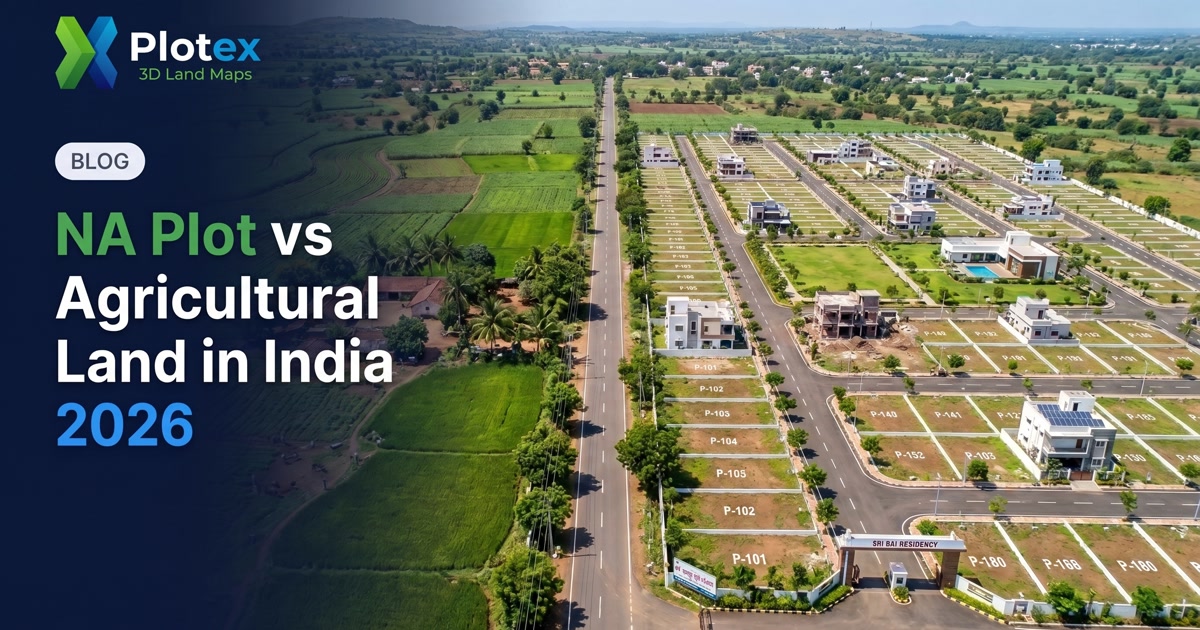
The single most expensive mistake a first-time plot buyer makes in India is paying for agricultural land that was marketed to them as a "plot." The board says "residential plots for sale," the price is 30-40% below the NA rate next door, and the broker shows a colourful layout — but the land's legal status is still agricultural. On that land you cannot get a building sanction, you cannot get a home loan, and you may never be able to resell cleanly.
This guide explains the real difference between an NA (Non-Agricultural) plot and agricultural land, why it decides whether you can ever build, the state-wise conversion process (NA / DC conversion / NALA / diversion), what it costs, and the exact documents to demand before you pay a single rupee of token money.
Quick takeaway: Agricultural land is for farming only — no building permit, no home loan, high resale risk. An NA plot has been legally converted for residential use by the revenue authority, so it is buildable, financeable and safely registrable. The land can look identical; the legal land-use record is what changes everything. Never pay for a "plot" until you have seen the NA order for that survey number.
What "NA" Actually Means
NA stands for Non-Agricultural. In India, every parcel of land carries a legally recorded land use in the revenue records. By default, most land outside municipal limits is classified as agricultural — meant for cultivation. To build a house, a shop, or a factory on it, the owner must first get the land's use officially changed from agricultural to non-agricultural. That order — issued by the District Collector or the state revenue authority — is what makes it an "NA plot."
Once converted, the change is reflected in the land record (7/12 extract, RTC, khata, or khasra depending on the state), and the plot becomes eligible for a building-plan sanction from the local municipal or planning body.
Crucially, NA conversion and layout approval are two different things. NA conversion changes the land use; a DTCP / town-planning / metropolitan-authority layout sanction approves the actual sub-division into individual plots with roads, open space and plot numbers. A safe residential plot needs both — plus RERA registration if a developer is marketing it.
Why the Difference Decides Everything
Buyers underestimate this because the two look the same on the ground. Here is what actually changes with the legal status:
- Building permission — On agricultural land, no municipal body will sanction a building plan. Any structure you build is unauthorised and can be demolished or penalised.
- Home / plot loan — Banks like SBI, HDFC, ICICI and Axis do not finance agricultural land for housing. If you can't get a loan on a "cheap plot," that is often because it isn't NA. (See our plot loan eligibility guide.)
- Utilities — Legal electricity and water connections usually require a sanctioned building on NA land; agricultural connections are meant for farming, not homes.
- Resale & liquidity — An unconverted "plot" is hard to resell because the next buyer's lawyer and bank will flag the same problem. NA plots trade freely.
- Who can even buy — Several states (Maharashtra, Karnataka, Gujarat) restrict purchase of agricultural land to agriculturists or impose land-ceiling limits, so a non-farmer buyer may not legally hold it at all. NA land does not carry that restriction.
NA Plot vs Agricultural Land — Side by Side
| Parameter | Agricultural Land | NA (Non-Agricultural) Plot |
|---|---|---|
| Legal use | Farming / cultivation only | Residential / commercial / industrial |
| Can you build? | No — needs conversion first | Yes — after building-plan sanction |
| Home / plot loan | Generally refused | Available (if RERA / DTCP-approved) |
| Price | Lower (looks like a "deal") | Higher — reflects legal buildability |
| Buyer eligibility | Often restricted to agriculturists | Open to any buyer |
| Key document | 7/12 / RTC showing agriculture | NA order + DTCP layout + RERA |
| Resale risk | High | Low |
How NA Conversion Works (Step by Step)
The mechanism is broadly similar across India, even though the name and portal differ. Whoever owns the land — the developer or the original farmer — applies to convert it before selling buildable plots:
1. Confirm zoning eligibility
The land must fall in a zone where residential use is permitted under the regional/development plan. Land in a "green zone," forest, or notified agricultural belt may not be convertible at all — check the zoning certificate first.
2. Apply to the revenue authority
The owner files a conversion application with the District Collector / Deputy Commissioner (or the state land-use portal) for the specific survey / gat number, with the title deed, current 7/12 or RTC, survey map, and the proposed use.
3. NOCs & scrutiny
Departments (town planning, roads/highways, pollution, sometimes irrigation) issue NOCs; the authority verifies title, encumbrances and zoning.
4. Pay the conversion charge
The owner pays the state-set conversion fee (a percentage of land value or a per-square-metre rate by zone). Higher for commercial/industrial than residential.
5. NA order issued + record updated
The Collector issues the NA / conversion order and the land record is mutated to show non-agricultural use. Only now is it a genuine NA plot — and only then should a layout be sanctioned and plots sold.
State-Wise: Same Idea, Different Name
The concept is national, but the terminology and department change by state. Confirm you are looking at the right document for the right state:
- Maharashtra / Gujarat — "NA conversion" / "NA order" from the Collector. Gujarat uses Sections 65/66 of the Land Revenue Code; Maharashtra also has "Gunthewari" regularisation for older unauthorised plots.
- Karnataka — "DC conversion" (Deputy Commissioner conversion); the plot record moves from RTC (agriculture) to a converted khata.
- Telangana & Andhra Pradesh — "NALA" (Non-Agricultural Land Assessment) conversion, applied online; look for the NALA certificate.
- Madhya Pradesh, Chhattisgarh, Rajasthan — called "diversion" (bhu-vyapvartan) of land use.
- Haryana, Punjab, Uttar Pradesh — "CLU" (Change of Land Use) / land-use conversion, often alongside DTCP or development-authority layout licensing.
Whatever the label, the buyer's job is the same: see the actual conversion order for your survey number, not a generic promise that "conversion is in process."
What NA Conversion Costs
There is no single national figure — the conversion charge is fixed by each state and usually depends on the land's market value or a zone-wise rate per square metre, plus scrutiny and application fees. As a rule of thumb:
- Residential conversion is cheaper than commercial or industrial.
- Charges are commonly expressed as a percentage of the ready-reckoner / guideline value, or a fixed rate per sq.m by zone.
- Add professional and NOC costs, and the time — conversion can take weeks to months.
For a buyer, the practical point is this: if a plot is genuinely NA, the seller has already paid this and can show you the order. If they're asking you to buy now and "convert later," you are taking on the cost, the delay, and the risk that it may never convert.
The "Gram Panchayat Plot" Trap
One of the most common traps in India is the gram panchayat plot — land sold with only a panchayat-level receipt or a house-tax number, marketed as approved. A panchayat NOC or tax entry is not an NA conversion and not a DTCP layout sanction. Buyers assume "it has a number, so it's legal," then discover they can't get a loan or a building permit.
Treat a panchayat receipt as the beginning of your due diligence, not the end. Demand the NA order and the planning-authority layout approval. This is exactly the kind of warning sign we cover in our top 10 red flags before buying an open plot.
How to Verify a Plot Is Really NA Before You Pay
Before token money, get and independently verify — do not rely on photocopies the broker hands you:
- The NA / DC / NALA / diversion order for that exact survey / gat / khasra number.
- Current 7/12 extract, RTC, or land record showing the non-agricultural use (pull it yourself from the state land-records portal).
- DTCP / metropolitan-authority layout approval — the sanctioned plan with plot numbers, roads and open space.
- RERA registration if it's a developer-marketed layout — verify the number on your state RERA portal. (See our RERA-approved plots guide.)
- Encumbrance certificate to confirm clear title with no loans/disputes.
- Match the plot on the ground to the sanctioned layout — the plot number, dimensions and boundaries must match the approved plan, not just the brochure.
Run through the full pre-purchase sequence in our 9-point plot verification checklist.
Where 3D Plot Visualization Helps
The hardest step for a remote or first-time buyer is step 6 — confirming that the specific plot on the ground actually matches the sanctioned NA layout. Paper plans are hard to read, and a site visit rarely tells you which numbered plot is which. An interactive 3D plot view turns the approved layout into a navigable map where you can see each plot's number, dimensions, road frontage and neighbours — so you can line up "the plot I'm buying" against "the plot that was legally sanctioned" before you pay, even from another city or country.
The Bottom Line
"NA plot vs agricultural land" is not a technicality — it is the difference between an asset you can build on, borrow against and resell, and a cheap-looking parcel that can trap your money for years. The land may look identical; the legal land-use record does not. Before you pay, insist on the NA order, the DTCP layout sanction, and RERA registration for the exact survey number — and match the on-ground plot to the approved plan. If a seller can't show all three, the "deal" isn't a plot yet.

Frequently Asked Questions
What is the difference between an NA plot and agricultural land?
Agricultural land is legally meant only for farming — you cannot build a house, get a building permit, or usually get a home loan on it. An NA (Non-Agricultural) plot has been officially converted by the revenue authority for residential, commercial, or industrial use, so it is legal to build on, financeable, and safely registrable. The land can look identical; the difference is the legal land-use classification recorded in the revenue records.
Can I build a house on agricultural land in India?
No — not legally, until the land is converted to Non-Agricultural (NA) use. Building on unconverted agricultural land is unauthorised: it can be demolished or penalised, and the municipal body will not sanction a building plan. You must first obtain an NA / DC conversion / NALA / diversion order from the District Collector or revenue authority, then get building-plan approval.
Will a bank give a home loan on agricultural land?
Generally no. Major Indian banks (SBI, HDFC, ICICI, Axis) do not sanction home or plot-purchase loans on agricultural land because it is not a legally constructable asset. They finance NA / DTCP-approved / RERA-registered residential plots. If a seller markets 'cheap farm plots' but you cannot get a loan on them, that is a red flag the land is still agricultural.
How much does NA conversion cost in India?
NA conversion cost is set by each state and is typically a conversion charge based on a percentage of the land's market value or a fixed rate per square metre by zone, plus application and scrutiny fees. It commonly ranges from a few thousand rupees to a few percent of land value for residential conversion, and more for commercial use. Always check your state's current conversion-charge schedule, as rates differ widely between Maharashtra, Karnataka, Telangana and Gujarat.
What is a gram panchayat NA plot — is it safe?
A 'gram panchayat plot' has only a panchayat-level approval (often just a property/house-tax number), which is NOT the same as a formal NA conversion plus DTCP/town-planning layout approval. Many disputes come from buyers assuming a panchayat NOC means the plot is legal to build on. Insist on the actual NA order, the DTCP/planning-authority layout sanction, and RERA registration if it is a developer layout — a panchayat receipt alone is not enough.
How do I verify that a plot is really NA before buying?
Ask for and independently verify: (1) the NA / DC / NALA / diversion order for that survey number, (2) the current 7/12 extract, RTC or land record showing non-agricultural use, (3) the DTCP / metropolitan-authority layout approval, (4) RERA registration if developer-marketed, and (5) an encumbrance certificate. Cross-check the survey number and boundaries against the approved layout — a 3D plot view helps you match the on-ground plot to the sanctioned plan before you pay.
Disclaimer: This article is general information only and is not legal, financial or investment advice. Land-use conversion rules, terminology, charges and eligibility vary by state and change over time. Always verify the specific survey-number records on your official state land-records and RERA portals, and consult a qualified advocate before making any payment or purchase. Plotex is an independent 3D plot-visualisation service and is not a government or legal authority. Verify every detail independently; Plotex accepts no liability for decisions made based on this content. See our Terms of Service.