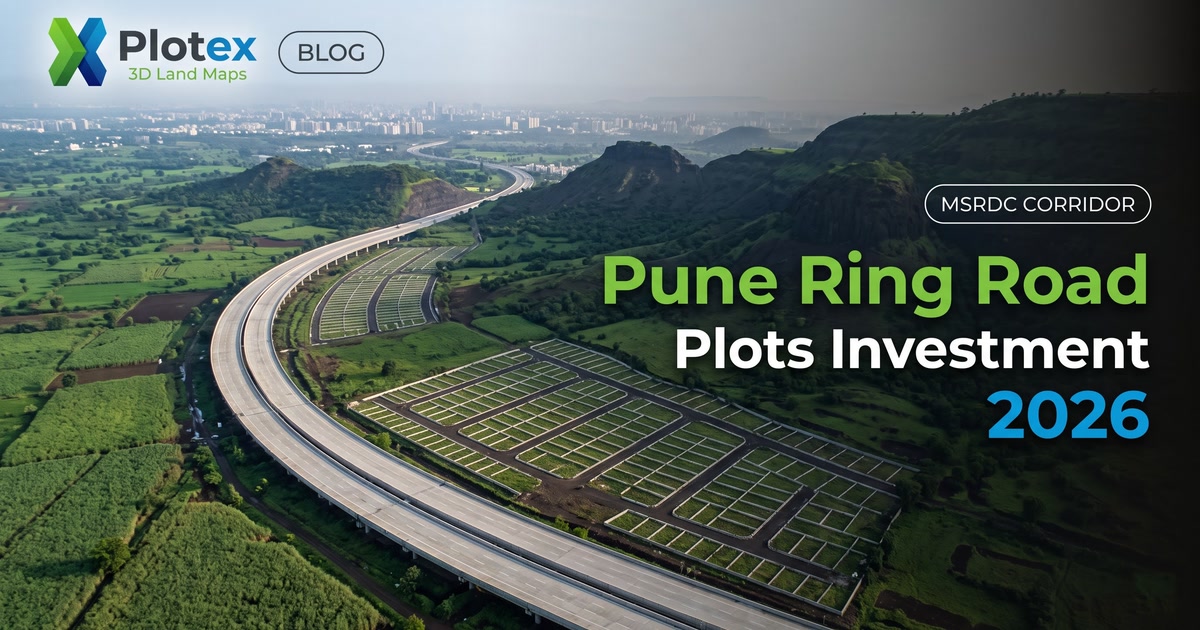
Pune has spent two decades growing outward faster than its roads could carry it. The Pune Ring Road — roughly 172 km of six-lane, access-controlled highway being built by MSRDC around the city — is the state's answer, and it is the single biggest thing happening to land values in the district right now. What makes 2026 different from the previous ten years of announcements is simple: the money has moved. Compensation rates are being finalised village by village and awards are being paid out, which means the corridor has crossed from proposal into execution.
That shift changes the calculation for a plot buyer completely. It also creates a specific, expensive trap that catches people on every acquisition corridor in India — buying land that is itself being acquired. This guide covers what the ring road actually is in 2026, which talukas it touches, how to tell a genuine corridor plot from a speculative one, the Maharashtra-specific approvals that decide whether you can ever build, and the verification sequence that keeps your money safe.
Quick takeaway: The Pune Ring Road is a funded, under-construction MSRDC project — a real catalyst, not a rumour. But the corridor's biggest risk is not the road failing; it is buying land inside the alignment or under a reservation, which cannot lawfully be sold to you as a plot. Pull the current 7/12 extract for the exact survey number, read the "other rights" column, confirm NA conversion or a sanctioned PMRDA layout, and check MahaRERA before any payment.
What the Pune Ring Road Actually Is in 2026
The project is a full orbital around Pune, executed by the Maharashtra State Road Development Corporation (MSRDC) and split into an eastern and a western arc so the two halves can progress independently. Reported figures put the total length near 172 km at a cost in the region of ₹42,000 crore, built to a wide right-of-way as an access-controlled corridor — which matters more than it sounds, because access control means traffic enters only at designated interchanges.
Through 2025 and into 2026 the story has been land acquisition converting into construction. Compensation rates have been finalised for batches of villages and award notices issued in tranches, with the state releasing funds progressively. Some sections have seen work start while others are still completing acquisition. For a buyer, that unevenness is the useful signal: the arcs where compensation is settled and contractors are mobilised are the ones where connectivity — and therefore plot demand — arrives first.
One clarification worth making before you talk to any broker. PMRDA has its own inner ring road proposal, which is a separate, smaller project from the MSRDC orbital. Sellers routinely blur the two, and "our plot is on the ring road" can mean either — or neither. Ask which road, then check the alignment yourself.
The Corridor — Where the Ring Actually Runs
The alignment sweeps through the outer talukas around Pune rather than the built-up city, which is precisely why plotted development follows it. Broadly, it touches:
| Taluka / belt | Character | Typical buyer |
|---|---|---|
| Maval | Expressway-side, industrial + weekend-home demand | Investor + second-home |
| Mulshi | Scenic west, farmhouse and premium plotting | Second-home + investor |
| Haveli | Closest to the city, most competitive rates | End-user + investor |
| Khed | Northern industrial belt, Chakan influence | Industrial + early investor |
| Bhor / Velhe | Southern, early-stage, lowest entry price | Patient long-horizon |
| Purandar | South-east, airport-proposal linked | Speculative + patient |
Read this table as a map of risk, not just geography. Haveli and Maval are the safest because demand already exists independently of the road — the ring accelerates something that was happening anyway. Bhor, Velhe and Purandar are cheap because the demand is almost entirely anticipated. Both can work; they are simply different bets, and the discount you are being offered in the south is the market pricing that difference honestly.
The other thing to understand is that on an access-controlled corridor, proximity alone is worth very little. A plot two kilometres from an interchange is far better placed than a plot that physically abuts the carriageway with no way onto it. When you evaluate a layout, find the nearest interchange first — that, not the road itself, is what will move the rate.
The Acquisition Trap — The Mistake That Costs the Most
Here is the risk that is specific to a corridor in the acquisition phase, and it catches buyers every year.
Land that falls inside the notified alignment or under a reservation is being taken by the state. It cannot lawfully be sold to you as a buildable plot. Once an acquisition notification covers a survey number, transactions on that land are restricted, and what a seller would actually be handing you is a compensation claim you have no right to enforce. People do get caught here, usually because they were shown a layout drawn before the notification, or because the affected portion is only part of a larger survey number and the seller simply did not mention it.
The check is not complicated, and it is not optional. Pull the current 7/12 extract for the exact survey and sub-division number — not a copy the seller provides, a fresh one — and read the "other rights" (itar hakk) column. Acquisition entries, reservations, encumbrances, loan charges and litigation notes all appear there. Then look at the mutation (ferfar) entries to see the recent history of the land. If a survey number is partially affected, you need to know whether your sub-division is in the affected part.
Rule of thumb: On any acquisition corridor, a plot that is unusually cheap for its location is cheap for a reason. The two most common reasons are that it sits in the alignment, or that it is still agricultural land with no realistic path to NA conversion. Both are recoverable only by not buying.
NA Conversion — The Maharashtra Approval You Can't Skip
Land in Maharashtra outside developed limits is agricultural by default. To build on it, or to get a plot loan against it, it must be converted to non-agricultural (NA) use under the Maharashtra Land Revenue Code, or sit inside a sanctioned layout where that conversion has already been done at the layout level.
A large share of "affordable" corridor plots around Pune are still agricultural, sold on the strength of the road and a promise that NA is "in process." That promise has no legal weight. Ask for the actual NA order, or the PMRDA-sanctioned layout approval with your plot number visible on the sanctioned plan. If neither exists, you are buying farmland at plot prices and taking on the entire conversion risk yourself — including the possibility that the zoning never permits it. Our guide on NA plot vs agricultural land explains exactly how this decides whether you can ever build.
There is a related point on PMRDA layout sanction specifically. A sanctioned layout is what guarantees you the things that make a plot liveable rather than merely owned: road width, drainage, open space, and the plot's own legal identity in the plan. Buying an "internal plot" carved informally out of a survey number gives you none of that, however genuine the seller is. If you want the mechanics of how PMRDA sanctions layouts and which Pune corridors are worth attention, our PMRDA plot layouts guide covers it in detail.
How to Verify a Pune Ring Road Plot
1. Pull a fresh 7/12 and check "other rights"
Get the current 7/12 extract for the exact survey and sub-division number, and read the other rights (itar hakk) column for acquisition, reservation, loan or litigation entries. Then read the mutation (ferfar) entries for the ownership history. This one step eliminates most corridor traps.
2. Confirm NA conversion or sanctioned layout
Ask for the NA order under the MLRC, or the PMRDA-sanctioned layout with your plot number on the sanctioned plan. "In process" is not an approval.
3. Get an encumbrance certificate
Obtain the encumbrance certificate through the sub-registrar's office to confirm the title is clear of mortgages and charges over the relevant period.
4. Verify MahaRERA registration
Any developer-marketed plotted project of qualifying size must be registered with MahaRERA. Check the registration on the MahaRERA portal and confirm the layout and plot schedule match what you were shown. (See our RERA-approved plots guide.)
5. Match the plot on the ground to the sanctioned plan
Walk the site with the sanctioned layout in hand and confirm the plot number, dimensions, road frontage and neighbouring plots line up. Brochure maps are marketing; the sanctioned plan is the document that binds.
Where 3D Plot Visualization Helps
Pune's corridor plots attract a lot of buyers who cannot visit repeatedly — IT professionals working elsewhere in India, NRIs buying through family, and Mumbai investors treating Pune as a second market. For all of them, the step that goes wrong is the last one: confirming that the specific plot being sold is the same plot that appears on the sanctioned layout.
An interactive 3D plot view turns a flat PMRDA layout or survey PDF into a navigable map where each plot carries its number, dimensions, road frontage and neighbours. Instead of squinting at a scanned plan, a buyer can see where the plot actually sits, how it relates to the internal road, and whether the frontage they were promised exists. It does not replace legal due diligence — nothing does — but it closes the gap between "the plot I was shown" and "the plot on the sanctioned plan," from anywhere. If you are marketing plots along this corridor, our Pune plot layout page shows the format.

The Bottom Line
The Pune Ring Road is one of the more credible infrastructure catalysts in Indian plot investing right now, precisely because it has moved past the announcement stage into funded acquisition and construction. That credibility is also why the corridor is crowded, and why sellers are pricing anticipation aggressively.
The discipline that protects you is unglamorous. Work from the notified village list rather than a broker's map. Find the nearest interchange, not the nearest carriageway. Pull a fresh 7/12 and read the other-rights column before you feel anything about the plot. Insist on NA conversion or a sanctioned PMRDA layout, verify MahaRERA, and match the plot on the ground to the sanctioned plan. A ring road rewards the buyer who is early on a clean plot. It does nothing at all for the buyer who is early on a disputed one.
Frequently Asked Questions
What is the Pune Ring Road and what is its current status in 2026?
The Pune Ring Road is a roughly 172 km, six-lane access-controlled corridor being built by MSRDC around Pune, split into an eastern and a western arc and reported at a cost in the region of ₹42,000 crore. Through 2025 and into 2026 the project has been moving out of the land-acquisition phase and into construction, with compensation rates being finalised village by village and award notices issued in batches. Separately, PMRDA has its own inner ring road proposal, which is a different project — confirm which road a seller actually means before you treat it as a catalyst.
Which talukas and areas does the Pune Ring Road pass through?
The alignment runs through the outer talukas around Pune — broadly Maval, Mulshi, Haveli, Bhor, Velhe, Purandar and Khed — connecting the Mumbai-Pune Expressway side in the north-west round to the Solapur and Nagar highway sides in the east. In practice the plotting activity clusters where the ring meets an existing highway or a growth node, because those junctions get connectivity first. The taluka matters less than the specific village and survey number, so always work from the notified village list, not a general map.
Can I buy a plot on land that falls inside the Pune Ring Road alignment?
No — and this is the single most expensive mistake on this corridor. Land inside the notified alignment or under a reservation is being acquired by the state, so it cannot be lawfully sold to you as a buildable plot. Once a notification under the acquisition law covers a survey number, transactions on it are restricted and you would be buying a compensation claim you have no right to. Always pull the current 7/12 extract for the exact survey number and check for acquisition or reservation entries in the 'other rights' column before paying anything.
Do I need NA conversion for a plot near the Pune Ring Road?
Yes, if you want to build or take a plot loan. Land in Maharashtra outside developed limits is agricultural by default and must be converted to non-agricultural (NA) use under the Maharashtra Land Revenue Code, or fall under a sanctioned layout where that conversion has already been done. Many cheap corridor plots are still agricultural and are sold on a promise that NA is 'in process'. Insist on the actual NA order or the sanctioned PMRDA layout approval — a promise is not an approval.
Is a Pune Ring Road plot a good investment in 2026?
A funded, under-construction ring road is a genuine long-term catalyst, and Pune's corridor has state backing and released compensation, which is more than most announced projects can claim. But the gains go to buyers who are early on a clean, approved plot — not to buyers who overpay for proximity. Treat it as a five-to-ten-year horizon, buy inside a PMRDA-sanctioned and MahaRERA-registered layout with NA in place, and be sceptical of any plot priced as though the road is already open.
How do I verify a Pune plot before booking it?
Pull the current 7/12 extract and the mutation (ferfar) entries for the exact survey and sub-division number, check the 'other rights' column for acquisition, reservation, loan or litigation notes, get an encumbrance certificate through the sub-registrar, confirm the NA order or PMRDA-sanctioned layout, and verify MahaRERA registration for any developer-marketed project. Then match the plot on the ground — number, dimensions, road frontage — to the sanctioned layout plan. A 3D plot view makes that final match far easier, especially for buyers who cannot visit repeatedly.
Disclaimer: This article is general information only and is not legal, financial or investment advice. Project scope, costs, alignments, village lists and timelines change and vary by source; several figures cited come from third-party reports and government announcements that may be revised. Always verify a plot's 7/12 entries, acquisition or reservation status, NA conversion, PMRDA layout sanction, title and MahaRERA registration on the official Maharashtra land-records, PMRDA and MahaRERA portals, and consult a qualified advocate before making any payment. Plotex is an independent 3D plot-visualisation service and is not a government, legal or financial authority. Verify every detail independently; Plotex accepts no liability for decisions made based on this content. See our Terms of Service.